


Midterm Elections: Why History Says Don’t Bet Against the Market

Midterm Elections: Why History Says Don’t Bet Against the Market
Every two years, Washington gives investors another reason to worry. But if history teaches us anything about midterm elections, it’s that political uncertainty tends to create opportunity for patient investors.
Historically, midterm election years have been among the weakest periods for the stock market. Investors worry about potential changes in taxes, regulations, government spending, and the direction of economic policy. That uncertainty often translates into increased volatility and market pullbacks heading into Election Day.
But here’s the interesting part: The market has historically performed quite well once the election is behind us.
Since 1938, the S&P 500 has finished higher in approximately 95% of the 12-month periods following midterm elections. The average return during that period has been around 14%. And perhaps most interestingly, that pattern has held regardless of which political party wins or loses.
Why? Markets don’t necessarily care who wins as much as they care about uncertainty going away. Once investors have a better understanding of the political landscape, they can shift their attention back to what really drives stock prices: corporate earnings, economic growth, interest rates, and business investment.
The lesson isn’t that investors should try to time the market around elections. In fact, that’s often a costly mistake. It’s that political headlines can create a lot of noise without necessarily changing the long-term investment opportunity.
The bottom line: Washington changes, political parties come and go, and election headlines dominate the news cycle. But businesses continue to innovate, consumers continue to spend, and companies continue to generate profits.
Don’t let an election determine your investment strategy. History suggests that some of the best opportunities can emerge when uncertainty is at its highest.
After all, successful investing is about having a plan, not predicting the next election.
Colin Symons, CIO Lloyd Financial Group
Q3 GDP was 3.4% vs. exp. 3.2%, as consumption stays strong.
PCE inflation was right in line, at 0.5% m/m in the headline and 0.3% in the core. Going another digit in, all those were slightly below expectations, which seemed to give bonds a bid.
Personal Income was 0.2% m/m vs. exp. 0.3%, while Personal Spending was 0.5% vs. exp. 0.6%. Both sides a bit short, while spending remains above income.
Jobless Claims were 194K vs. exp. 198K, while Continuing Claims were 1.7MM vs. exp 1.72MM. Modest strength.
Binance lost about $3B in crypto om a wallet theft, where $6.3B was affected.
Polymarket is also reportedly seeing funds drained, sparking fears the platform is compromised.
MSFT is raising $25B in debt, their first debt raise since 2017. That hit bonds, as there is yet more demand for debt. While the initial kick against bonds was a bit rough, it relaxed some, I think because this is about as far from junk debt as you can get. Unsurprisingly, that debt drew incredible demand, with $115B in orders for it.
Reddit’s (RDDT) Daily Active Users (DAU) declined for the first time in four years, sending shares -22%.
Roblox (RBLX) was -17% as bookings were weak and the outlook disappointed.
Amazon (AMZN) is -7% after AWS growth looked good, but earnings missed, ads missed, and the guide was week.
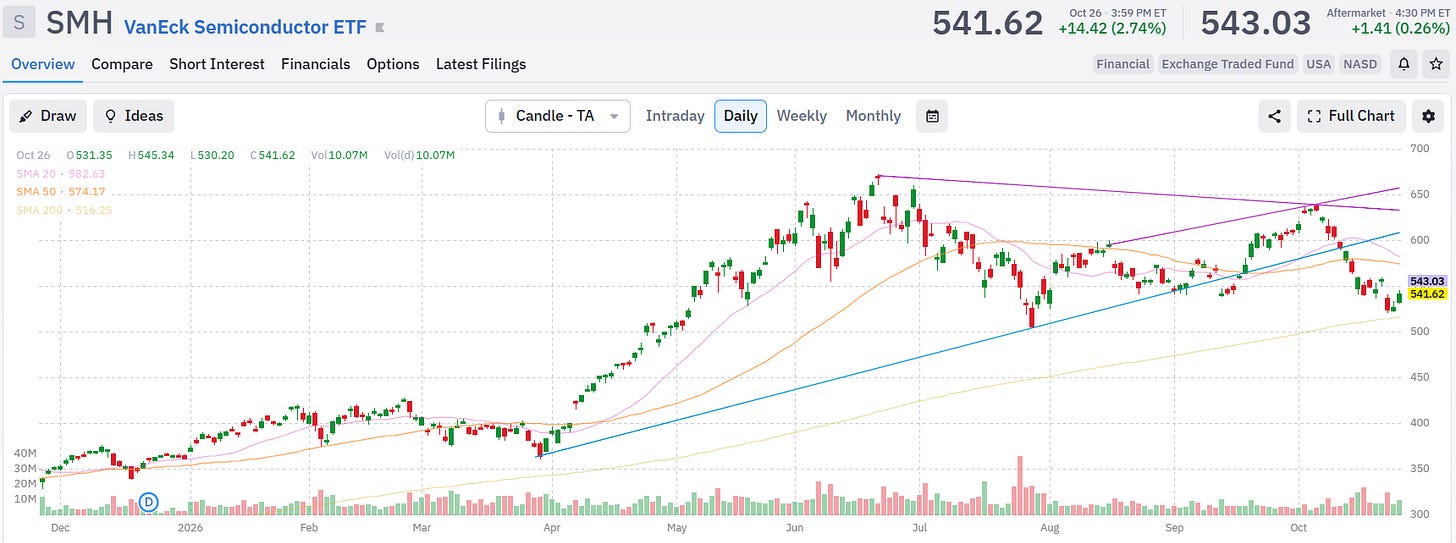
Sandisk (SNDK) numbers looked good, but it’s not a great day to be in the AI space, so, shares are -6%.
Intel (INTC) earnings were good but guidance was way below expectations due to an accident at their Israel plant and trouble with the supply chain, like memory pricing and packaging. Demand remains strong; they are just struggling to supply it. Shares are -25%.
Rivian (RIVN) is up 9% as the electric vehicle maker beats earnings and improved delivery guidance.
Employment Cost Index and Chicago PMI today.
Bottom Line: Really ugly in the AI space, though again the problem isn’t a lack of demand.
Click here to schedule a meeting — I’m here to help you take the next step toward financial freedom.
Disclosures/Regulation:
This content is intended to provide general information about Lloyd Financial. It is not intended to offer or deliver investment advice in any way. Information regarding investment services are provided solely to gain an understanding of our investment philosophy, our strategies and to be able to contact us for further information.
All information has been obtained from sources believed to be reliable, but its accuracy is not guaranteed. There is no representation or warranty as to the current accuracy, reliability or completeness of, nor liability for, decisions based on such information and it should not be relied on as such.
The views expressed in this commentary are subject to change based on market and other conditions. These documents may contain certain statements that may be deemed forward‐looking statements. Please note that any such statements are not guarantees of any future performance and actual results or developments may differ materially from those projected. Any projections, market outlooks, or estimates are based upon certain assumptions and should not be construed as indicative of actual events that will occur.
Past performance is no guarantee of future returns.
Different types of investments involve varying degrees of risk. Therefore, it should not be assumed that future performance of any specific investment or investment strategy will be profitable
Want a clearer view of where you stand? Schedule a free portfolio analysis.
Comments