


Perception vs. Reality: Why What You Believe About the Market Can Matter More Than What’s Actually Happening

Perception vs. Reality: Why What You Believe About the Market Can Matter More Than What’s Actually Happening
In investing, reality determines what something is worth over time. But perception often determines what investors are willing to pay for it today. Understanding the difference can make a tremendous difference in your financial future.
Imagine two investors looking at the exact same stock market.
One sees a market near record highs and worries that a crash must be around the corner. The other sees a growing economy, rising corporate earnings, and businesses finding new ways to make money. They have access to the same information, yet they reach completely different conclusions.
Which investor is right?
The answer may depend less on what the market is doing today and more on what happens next. But there’s a bigger lesson here: Investing isn’t just about understanding reality. It’s about understanding how people perceive reality, and how those perceptions influence their decisions.
This is one of the most overlooked aspects of successful investing and financial planning.
The Market Doesn’t Always Reflect Reality
Stock prices are supposed to reflect the value of future corporate earnings. In practice, however, prices also reflect expectations, emotions, fears, and optimism.
When investors believe the future will be bright, they may be willing to pay a premium for stocks. When they believe the future is uncertain, they may sell even perfectly healthy businesses.
Consider a company that continues to grow its revenue, generate cash flow, and develop new products. If investors suddenly become worried about the economy, that company’s stock could fall even though its underlying business hasn’t changed much.
The reverse can happen, too. A company with questionable fundamentals can see its stock rise when investors become excited about a new technology, a promising industry, or the possibility of future growth.
In both situations, perception can move prices faster than reality changes.
This creates opportunities, but it also creates risks.
When investors confuse a falling stock price with a deteriorating business, they may sell an investment that remains fundamentally sound. When they confuse a rising stock price with a great business, they may pay far more than the investment is worth.
Price is what the market is willing to pay today. Value is what an investment is ultimately worth. Those two numbers don’t always agree.
The challenge is knowing when the difference represents an opportunity and when it signals a legitimate problem.
Fear and Greed Can Become Self-Fulfilling
Perception is especially powerful because investors don’t operate independently of one another.
When investors become fearful, they sell. Those sales can push prices lower, creating more negative headlines and increasing anxiety among other investors. More people sell, and the cycle continues.
The same process works in the opposite direction.
When optimism spreads, investors buy. Rising prices attract attention, positive headlines encourage more buying, and investors who previously stayed on the sidelines begin to feel they’re missing out.
Eventually, the excitement can become disconnected from the underlying fundamentals.
We’ve seen this pattern throughout market history. Financial bubbles often develop when expectations become so optimistic that investors stop asking what an asset is actually worth. Market panics occur when fear becomes so widespread that investors sell first and ask questions later.
Neither extreme lasts forever.
Eventually, businesses must generate earnings, borrowers must repay their debts, and investments must produce economic value to justify their prices over the long term.
But investors can get into trouble long before reality catches up with perception.
Buying into excessive optimism can mean paying too much. Selling during excessive pessimism can mean abandoning an investment at precisely the wrong time.
The goal isn’t to ignore sentiment. It’s to recognize when sentiment may be distorting your judgment.
The Headlines Can Be True Without Telling the Whole Story
One of the most dangerous things an investor can do is confuse a true headline with a complete picture of reality.
Consider a news report announcing that the national debt has reached another record. The headline may be accurate, and the debt may represent a legitimate long-term economic concern.
But what does that information mean for your portfolio today?
Does it mean every stock should be sold? Does it mean the economy is about to collapse? Does it mean bonds will inevitably lose money?
Not necessarily.
The implications depend on many factors, including economic growth, interest rates, inflation, government policy, corporate earnings, and the expectations already reflected in market prices.
The same principle applies to inflation reports, unemployment numbers, political developments, and international conflicts.
A negative economic report doesn’t automatically mean stocks must fall. If investors were expecting even worse news, markets might actually rise. A strong economic report doesn’t guarantee a rally, either. If investors were expecting exceptional results, merely good news might disappoint them.
Markets don’t simply react to whether news is good or bad. They react to how reality compares with expectations.
This distinction explains why investors sometimes find market movements so confusing. They see positive news accompanied by falling stock prices or negative headlines alongside a rising market.
The market isn’t necessarily ignoring reality. It may simply be reacting to a different reality than the one investors expected.
For financial planning purposes, this is an important reminder that making investment decisions based on individual headlines can be a costly mistake.
Your Personal Perception Can Be Just as Dangerous
Market sentiment is only part of the equation. Your own perception of risk can have an even greater influence on your financial future.
Think about an investor who watches their portfolio increase substantially over several years. As their account balance grows, they begin to believe they’re a better investor than they actually are.
They take on more risk, concentrate their holdings, or invest in opportunities they don’t fully understand.
Then the market experiences a significant correction.
Suddenly, the same investor who felt comfortable with risk becomes convinced that the financial system is broken. They sell their investments, move into cash, and wait for things to feel safe again.
The problem is that markets rarely provide a clear signal that it’s time to get back in.
Prices may recover while the investor remains on the sidelines, waiting for reassuring headlines that arrive only after much of the recovery has occurred.
This is how perception can turn temporary market volatility into a permanent financial setback.
The investor may have had a perfectly reasonable long-term investment strategy. What changed wasn’t necessarily the strategy’s merits. It was the investor’s emotional response to a changing account balance.
This is why a sound financial plan must account for more than mathematical risk tolerance.
It must also consider how you are likely to behave when markets become uncomfortable.
Knowing you can tolerate a 20% decline in theory is very different from watching your portfolio lose hundreds of thousands of dollars in practice.
A good financial plan acknowledges that difference before the next downturn arrives.
Why Long-Term Investors Need to Look Beyond the Noise
If perception can distort market prices, should investors try to predict how other investors will react?
Sometimes understanding market sentiment can be useful, but consistently predicting the next change in investor psychology is extremely difficult.
Instead, long-term investors can benefit from focusing on factors that are more measurable and relevant to their financial goals.
These include:
Corporate earnings: Are businesses generating profits and growing their underlying value?
Valuations: Are investors paying a reasonable price for the earnings and growth they expect?
Economic conditions: What do employment, inflation, interest rates, and economic growth suggest about the environment businesses face?
Portfolio diversification: Is your financial future overly dependent on one company, sector, asset class, or economic outcome?
Time horizon: When will you actually need the money, and how much flexibility do you have if markets decline?
Liquidity needs: Do you have enough accessible cash and other appropriate resources to avoid selling long-term investments at an unfavorable time?
These factors won’t eliminate uncertainty or guarantee positive returns. They can, however, help investors make decisions based on a broader picture rather than the emotions of the moment.
Sometimes the market is correctly identifying a problem that investors have underestimated. Other times, investors are overreacting to uncertainty.
The important thing is to distinguish between a temporary change in perception and a meaningful change in the underlying facts.
That requires research, discipline, and a willingness to question your own assumptions.
The Retirement Planning Connection: When Perception Changes Your Decisions
The relationship between perception and reality becomes particularly important in retirement.
Imagine two retirees with identical portfolios, similar spending needs, and the same life expectancy.
One retiree experiences a market decline and immediately concludes that retirement is no longer financially secure. They cut spending unnecessarily, abandon their investment strategy, and become afraid to enjoy the money they spent decades accumulating.
The other retiree also recognizes the decline but evaluates it in the context of a comprehensive financial plan.
They review their income sources, cash reserves, spending flexibility, portfolio allocation, and long-term projections. They determine whether the decline has materially changed their ability to meet their goals before deciding what adjustments, if any, are necessary.
The market decline is real for both investors. But their perceptions lead them toward very different decisions.
This doesn’t mean the second retiree should dismiss losses or assume everything will work out. A market decline can have serious consequences, particularly for someone withdrawing money from investments early in retirement.
It means that a change in portfolio value should trigger an evaluation, not an automatic emotional reaction.
Retirement planning should help answer the questions that headlines cannot.
Can you still afford your desired lifestyle? Is your withdrawal strategy sustainable under a range of market conditions? Do you have adequate liquidity? Has your financial situation changed enough to justify adjusting your plan?
When those questions have been addressed in advance, investors are better equipped to separate temporary market anxiety from a genuine financial problem.
The objective isn’t to eliminate worry entirely. It’s to build a financial plan that gives you a clearer understanding of what you can control, what you cannot control, and what actions are actually necessary.
Sometimes the Greatest Opportunity Exists When Perception Is at Its Worst
There’s another side to this relationship.
When fear dominates the market, investors can become so focused on potential losses that they overlook opportunities.
Businesses with durable competitive advantages may trade at lower valuations. Investors may become excessively pessimistic about entire industries. Temporary economic weakness may be mistaken for permanent business deterioration.
For patient investors with appropriate time horizons, liquidity, and risk capacity, these situations can create attractive opportunities.
But there’s an important distinction between recognizing an opportunity and assuming every decline is a buying opportunity.
Sometimes falling prices reflect genuine deterioration. A company may face permanent competitive disadvantages, excessive debt, or a business model that no longer works. A low valuation alone doesn’t make an investment attractive.
The objective is not to automatically buy when others are fearful. It’s to evaluate whether the price adequately compensates you for the risks involved.
The same discipline applies when markets are rising.
Rather than assuming a rally will continue indefinitely, investors should consider whether valuations, earnings expectations, and portfolio exposures still make sense.
Successful investing requires the ability to think independently without assuming that the crowd is always wrong.
Sometimes the market is right. Sometimes it isn’t.
Your job is to understand the difference as best you can.
A Financial Plan Can Help Separate Feelings From Facts
Investors cannot control market prices, economic conditions, or the emotions of millions of other market participants.
They can control how they prepare and respond.
A well-constructed financial plan establishes a framework for making decisions before emotions take over. It connects investments to specific goals, incorporates cash-flow needs, considers tax consequences, and evaluates how different market environments could affect your financial future.
It also helps investors recognize that the right decision depends on their individual circumstances.
A 35-year-old accumulating wealth for retirement may have decades to recover from a market downturn. Someone who retired last year and depends on portfolio withdrawals may need a very different strategy.
Neither investor should base their decisions solely on market sentiment.
Their investment decisions should reflect their goals, financial resources, time horizons, and ability to absorb losses.
Regular reviews can also help identify when a change in the underlying facts warrants a change in strategy. If your circumstances, spending needs, or investment assumptions have changed, your plan may need to change, too.
The key is to make adjustments for a reason rather than reacting to every shift in market perception.
At the end of the day, a financial plan should do more than tell you how much money you might accumulate. It should help you understand what your money is intended to accomplish and how to respond when the road gets bumpy.
Don’t Let Perception Dictate Your Financial Future
Investing is ultimately a contest between expectations and reality.
In the short term, perception can dominate. Fear can drive prices below what fundamentals might justify, while optimism can push valuations beyond reasonable expectations.
Over longer periods, economic reality matters enormously. Businesses must produce results, investments must generate value, and financial plans must withstand the demands of real life.
But even when reality eventually asserts itself, investors can make costly mistakes along the way by allowing their perceptions to dictate their decisions.
The answer isn’t to ignore the news, dismiss risk, or assume the market will always recover on your preferred timeline.
It’s to develop the discipline to distinguish between what is happening, what you believe is happening, and what those differences actually mean for your financial future.
At Lloyd Financial Group, we believe good financial planning starts with understanding the full picture. Your investments are only one part of the equation. Your retirement income, tax strategy, family priorities, risk tolerance, and long-term goals all matter, too.
Because building wealth isn’t just about earning a return. It’s about making thoughtful decisions when uncertainty makes those decisions difficult.
The goal isn’t to predict every twist and turn in the market. It’s to build a financial plan that helps you stay focused on what matters, even when everyone else is focused on what they’re afraid of.
Dream Bigger, Sleep Better.
Click here to schedule a meeting — I’m here to help you take the next step toward financial freedom.
Colin Symons, CIO Lloyd Financial Group
The FOMC voted 10-2 to keep rates stable, with two voting for a hike. Expectations were for 2-3 dissents, so that seems as expected. The statement basically says wait and see, in my mind.
Warsh’s presser said growth is broadening beyond AI and the AI boom means they may not need to do much more to get an appropriate level of rates.
Advance goods trade balance was a -$135B deficit vs. exp. -$130.4B.
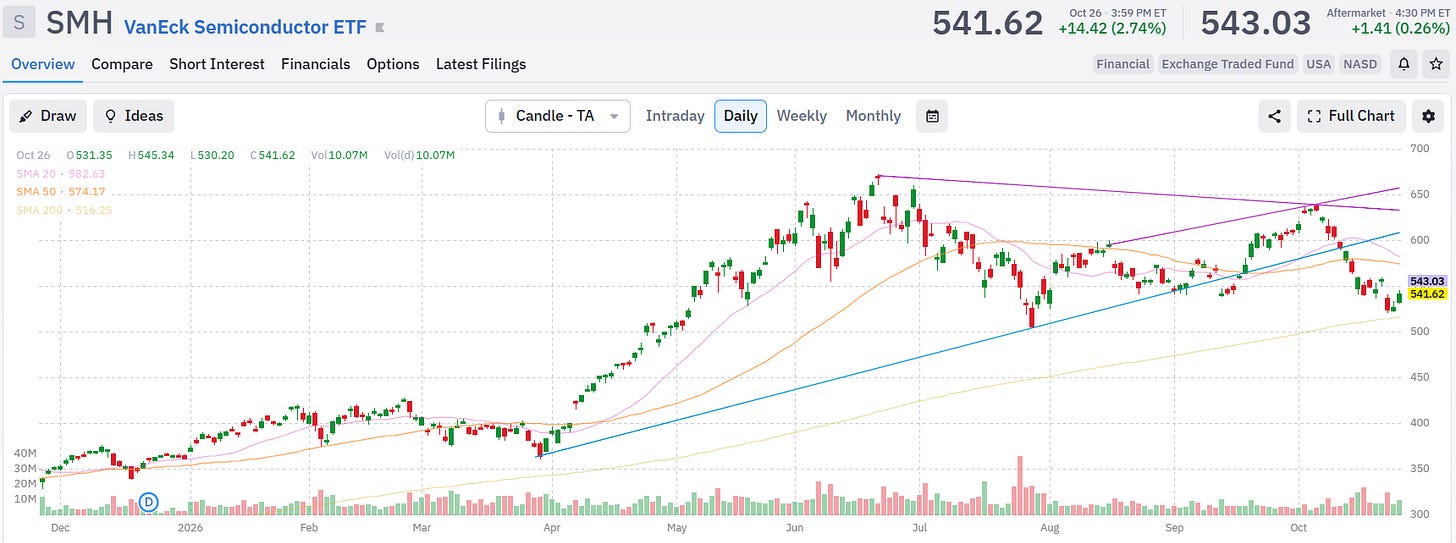
Samsung echoed SKHY, saying the memory shortage will get worse next year and they’re spending big to meet demand, though shares were -4% in part on GOOG worry. I’m sure the big spending doesn’t help either.
Oracle (ORCL) was up 11% after their update said free cash flow would turn positive in the second half of 2028 and would hit $30B in 2029 as capex peaks. They also said capital raises through 2030 would be capped at $20B.
ServiceNow (NOW) is -17% after earnings slightly missed and future bookings guidance was a little light, though they raised free cash flow guidance.
GOOGL is -10% as their cloud business looks great, and everything else looks lousy, with free cash flow even more negative than expected amid big AI spending and expectations that big spend continues.
MSFT beat earnings and capex was less than expected, sending shares up 3%.
Fortinet (FTNT) is -25% after great numbers and guidance were overwhelmed by rising inventories and slowing growth in the services business.
KLA Corp (KLAC) raised guidance on AI demand for chip tools, sending shares up 3%.
Jobless Claims, GDP, and PCE inflation, with the last one likely the most important. We also have the ECB rate decision this morning and BoJ tonight.
Bottom Line: Very noisy newsflow today.
Click here to schedule a meeting — I’m here to help you take the next step toward financial freedom.
Disclosures/Regulation:
This content is intended to provide general information about Lloyd Financial. It is not intended to offer or deliver investment advice in any way. Information regarding investment services are provided solely to gain an understanding of our investment philosophy, our strategies and to be able to contact us for further information.
All information has been obtained from sources believed to be reliable, but its accuracy is not guaranteed. There is no representation or warranty as to the current accuracy, reliability or completeness of, nor liability for, decisions based on such information and it should not be relied on as such.
The views expressed in this commentary are subject to change based on market and other conditions. These documents may contain certain statements that may be deemed forward‐looking statements. Please note that any such statements are not guarantees of any future performance and actual results or developments may differ materially from those projected. Any projections, market outlooks, or estimates are based upon certain assumptions and should not be construed as indicative of actual events that will occur.
Past performance is no guarantee of future returns.
Different types of investments involve varying degrees of risk. Therefore, it should not be assumed that future performance of any specific investment or investment strategy will be profitable
Want a clearer view of where you stand? Schedule a free portfolio analysis.
Comments