


Should I Pay Off My Mortgage Before Retirement?

Should I Pay Off My Mortgage Before Retirement?
For many people approaching retirement, one financial goal stands above the rest: paying off the mortgage.
After decades of working, saving, and raising a family, the idea of entering retirement without a monthly mortgage payment sounds like financial freedom. No house payment means fewer expenses, less financial pressure, and more flexibility to enjoy the next chapter of life.
But is paying off your mortgage before retirement always the smartest financial decision?
Not necessarily.
Depending on your mortgage interest rate, investment portfolio, retirement income, and tax situation, paying off your home could be an excellent move—or it could leave you with less financial flexibility than you anticipated.
The key is understanding how your mortgage fits into your overall retirement plan.
The Benefits of Paying Off Your Mortgage Before Retirement
There is a reason so many retirees want to eliminate their mortgage. The benefits go beyond simple mathematics.
1. Lower Monthly Expenses in Retirement
One of the most effective ways to improve retirement security is to reduce the amount of money you need to withdraw from your investments each month.
If you retire with a $2,500 monthly mortgage payment, that represents $30,000 per year in expenses. Eliminating that payment could significantly reduce the income your retirement portfolio needs to generate.
Lower expenses can provide several advantages:
Smaller withdrawals from retirement accounts.
Greater flexibility during stock market downturns.
Less pressure to generate investment income.
More money available for travel, hobbies, and family.
Greater confidence that your retirement savings will last.
Your property taxes, homeowners insurance, maintenance, and other housing costs will remain, but removing the principal and interest portion of your mortgage can make a meaningful difference.
A retirement plan should not simply focus on how much money you have accumulated. It should also consider how much income you need to support the life you want to live.
Reducing your fixed expenses can make that goal easier to achieve.
2. Greater Peace of Mind
Retirement is a major transition. You are moving from a period when your paycheck regularly replenishes your bank account to one when your savings and investments must help support your lifestyle.
That transition can create uncertainty, even for people with substantial wealth.
Eliminating your mortgage can remove one of the largest fixed expenses from your budget. For some retirees, the psychological benefit of knowing their home is paid off is worth more than the potential financial return of keeping a low-interest mortgage.
Personal finance is not purely mathematical.
If being debt-free helps you sleep better at night, that preference deserves consideration in your retirement plan.
The goal is not to maximize every dollar at the expense of your happiness. It is to make financial decisions that allow you to enjoy the wealth you spent decades building.
3. Less Reliance on Your Investment Portfolio
Imagine retiring with $1.5 million in investment assets and a mortgage requiring $30,000 in annual payments.
If you pay off the mortgage, you may be able to reduce the amount you withdraw from your portfolio each year.
That can be especially valuable when the stock market experiences a significant decline early in retirement.
Selling investments to cover living expenses during a market downturn can permanently reduce the amount of capital available to participate in a recovery. This is one reason financial planners pay close attention to the sequence of investment returns during the early years of retirement.
Lowering your expenses can reduce the need to sell investments when markets are down.
However, there is an important trade-off: using $300,000 of your portfolio to pay off a mortgage also reduces the amount of money available for emergencies, unexpected expenses, and future investment growth.
The right decision depends on how your remaining assets would support your retirement income needs.
The Potential Downsides of Paying Off Your Mortgage
Paying off your mortgage can be beneficial, but it is important to consider what you give up in exchange.
1. You Could Lose Valuable Liquidity
One of the biggest mistakes retirees can make is becoming asset-rich but cash-poor.
Your home may be worth $700,000, but that does not mean you can easily use that money to pay for healthcare, travel, or everyday expenses.
If you use a substantial portion of your liquid investment portfolio to eliminate your mortgage, you may have fewer readily accessible funds available for unexpected costs.
Consider a retiree with $1 million in investments and a $250,000 remaining mortgage.
Paying off the mortgage would reduce the investment portfolio to $750,000, assuming the payment comes entirely from those investments and excluding taxes, transaction costs, or other changes.
The retiree would have lower monthly expenses, but also less liquid capital.
Before paying off a mortgage, consider maintaining sufficient reserves for emergencies, healthcare expenses, home repairs, and other unexpected needs.
The objective is to eliminate unnecessary financial pressure without creating a different problem.
2. Your Investments Could Potentially Earn More Than Your Mortgage Costs
Suppose you have a mortgage with a 3% interest rate.
You also have $250,000 available that could be used to pay off the loan or remain invested in a diversified portfolio.
Paying off the mortgage provides a relatively predictable benefit: you avoid future interest costs associated with the debt.
Keeping the money invested creates an opportunity for additional growth, but that growth is uncertain. Investment returns fluctuate, and your portfolio could lose value.
It is tempting to compare a mortgage rate with an assumed investment return and choose whichever number looks better. However, that comparison is incomplete.
You should also consider:
Investment risk and potential losses.
Taxes on investment income and realized gains.
The remaining mortgage term.
Your need for accessible cash.
Your expected retirement withdrawals.
Your comfort with debt and market volatility.
A low-interest mortgage may be worth keeping if you have substantial liquid assets, a sound retirement income plan, and the financial capacity to tolerate investment risk.
On the other hand, a higher mortgage rate, limited retirement income, or a strong preference for debt-free living may support paying it off.
There is no guarantee that investments will outperform the cost of your mortgage over your retirement.
3. You May Trigger Taxes by Selling Investments
This is an especially important consideration for retirees with significant taxable investment accounts.
Suppose you have a $300,000 mortgage and want to pay it off by selling investments in a brokerage account.
If those investments have appreciated significantly, selling them could generate capital gains and an unexpected tax bill.
The amount of tax would depend on your cost basis, holding periods, other income, and applicable tax rules.
Selling investments held inside a traditional IRA or 401(k) can create a different problem. Withdrawals are generally taxable as ordinary income, and a large distribution could push you into a higher marginal tax bracket.
It could also affect Medicare income-related monthly adjustment amounts, commonly known as IRMAA, which can increase Medicare premiums based on income.
For example, withdrawing $300,000 from a traditional retirement account to pay off a mortgage could create a substantial tax liability. The actual consequences would depend on your circumstances, but the tax cost could make the strategy far less attractive than it initially appears.
Before liquidating investments to pay off your home, evaluate the tax consequences and consider whether spreading withdrawals across multiple years would be more efficient.
Sometimes, the best strategy is not simply deciding whether to pay off the mortgage. It is determining how to do so in the most tax-efficient manner.
Should You Pay Off Your Mortgage Before Retirement or Keep Investing?
There is no universal answer, but several factors can help guide the decision.
Paying off your mortgage may make sense if:
You have a relatively high mortgage interest rate.
Your retirement income comfortably covers your expenses after the payoff.
You will still have sufficient liquid savings.
Your investment portfolio is large enough to support your long-term needs.
You value the certainty and peace of mind of being debt-free.
Paying off the loan will not create an unnecessarily large tax bill.
Keeping your mortgage may make sense if:
You have a low, fixed interest rate.
You have sufficient income to comfortably cover the payment.
Paying off the loan would consume too much of your liquid savings.
You have significant upcoming expenses or healthcare needs.
Selling investments or withdrawing retirement funds would trigger substantial taxes.
You have a well-designed investment strategy and can tolerate the associated risks.
These are guidelines, not rigid rules. A retiree with a $2 million portfolio and a low-interest mortgage may reach a different conclusion than someone with $600,000 in investments and a mortgage payment that consumes a significant portion of their monthly income.
The right answer depends on the entire financial picture.
How Paying Off Your Mortgage Affects Your Retirement Taxes
Mortgage decisions should not be made independently of tax planning.
Your income sources, investment withdrawals, Social Security benefits, and retirement account balances can all influence the financial consequences of paying off your home.
Consider the Timing of Retirement Account Withdrawals
If you plan to use retirement accounts to pay off your mortgage, consider whether the timing of those withdrawals makes sense.
For example, the years between retirement and the beginning of Social Security or required minimum distributions may offer opportunities for strategic withdrawals or Roth conversions.
However, withdrawing a large amount in a single year to eliminate your mortgage could undermine an otherwise efficient tax plan.
Depending on your circumstances, it may be worth comparing several approaches:
Paying off the mortgage before retirement using existing cash.
Gradually paying down the mortgage over several years.
Keeping the mortgage and using investment income to cover the payment.
Making additional principal payments while maintaining adequate cash reserves.
Coordinating the payoff with a broader retirement tax strategy.
Each option has different implications for your cash flow, investment portfolio, and taxes.
The best approach is often the one that balances debt reduction with long-term tax efficiency.
Understand the Mortgage Interest Deduction
Some homeowners receive a federal tax deduction for qualifying mortgage interest, but the benefit is not automatic.
The deduction generally requires itemizing deductions, and eligibility depends on applicable tax rules and limits.
If you currently receive a mortgage interest deduction, paying off your mortgage could reduce your itemized deductions.
However, that does not automatically mean keeping the mortgage is financially preferable.
Paying interest to receive a partial tax deduction rarely makes sense by itself. The relevant question is whether the after-tax cost of the mortgage is worth the liquidity and investment flexibility you retain by keeping the loan.
Review the actual tax benefit rather than assuming your mortgage is inexpensive simply because some interest may be deductible.
What If You Are Five Years Away From Retirement?
If retirement is approaching, you have an opportunity to evaluate your mortgage before making a final decision.
Start by estimating your expected retirement income from Social Security, pensions, investment accounts, and other sources.
Next, determine your anticipated expenses, including housing, healthcare, taxes, travel, and discretionary spending.
Then compare your retirement cash flow under two scenarios:
Scenario One: You Retire With a Mortgage
Calculate how much income you will need to cover your mortgage payment and other expenses. Evaluate the portfolio withdrawals required to fund that lifestyle and whether those withdrawals remain sustainable during different market conditions.
Scenario Two: You Retire Without a Mortgage
Calculate how much money you would need to pay off the loan, what taxes you might incur, and how much liquid investment capital would remain afterward.
Then evaluate how your lower housing expenses affect your retirement income needs.
Comparing these scenarios can help reveal whether paying off your mortgage improves your financial security or unnecessarily limits your flexibility.
It can also help you determine whether a middle-ground approach makes sense, such as making additional principal payments over the next several years without liquidating a large portion of your investments.
What If You Are Already Retired?
If you are already retired and still have a mortgage, do not assume you made a mistake by carrying the loan into retirement.
The decision can still be evaluated based on your current financial circumstances.
Consider whether your retirement income comfortably covers the mortgage payment, whether you have sufficient liquid assets, and whether the loan creates unnecessary stress.
If your portfolio is strong and your mortgage payment is manageable, keeping the loan may be perfectly reasonable.
If the payment consumes too much of your income or forces you to withdraw more from investments than you are comfortable with, paying off the mortgage may improve your retirement experience.
You should also consider your age, health, plans for your home, and whether you expect to move in the future.
For some retirees, a mortgage is simply another manageable expense. For others, eliminating it can provide greater confidence and flexibility.
Neither approach is inherently right or wrong.
The Biggest Mistake: Making the Decision in Isolation
One of the most common financial planning mistakes is treating a major decision as though it exists independently of everything else.
Paying off your mortgage is not just a debt decision. It is also an investment decision, a tax decision, a cash-flow decision, and a lifestyle decision.
You might have enough money to pay off your home but still benefit from retaining the liquidity.
You might have a low-interest mortgage but prefer to eliminate the payment because doing so allows you to retire comfortably on a lower level of guaranteed income.
Or you might discover that paying off the mortgage in one year creates unnecessary taxes when a more gradual approach could achieve a similar goal.
The right decision should account for all these factors.
Your retirement plan should connect the dots between your investments, income, taxes, and spending so that one financial decision does not unintentionally undermine another.
Should You Pay Off Your Mortgage Before Retirement?
For some people, entering retirement debt-free is the right financial move. For others, keeping a manageable mortgage and preserving liquid investments may provide greater flexibility and long-term financial security.
The important thing is to understand the trade-offs before making the decision.
Start by evaluating your mortgage interest rate, retirement income, investment assets, tax situation, and expected expenses. Then compare how your retirement plan looks with and without the mortgage.
At Lloyd Financial Group, we believe retirement planning should go beyond simply accumulating assets. It should help you understand how your money works together to support the life you want to live.
That means looking at your investment portfolio, retirement income, tax strategy, and major financial decisions as parts of one coordinated plan.
Because the goal is not merely to retire with a paid-off house or a large investment account.
The goal is to build a financial plan that helps you enjoy retirement with confidence, knowing your money is working toward what matters most to you.
Dream Bigger, Sleep Better.
Click here to schedule a meeting — I’m here to help you take the next step toward financial freedom.
Colin Symons, CIO Lloyd Financial Group
Durable Goods Orders were 1.8% m/m vs. exp. 1.5% but Core Orders were 0.5% vs. exp. 0.7%. AI spending remains strong, though not outside what was expected, with cooling equipment spending bringing up the possibility future spending could be cooling.
New Home Sales were better than expected, at 676K vs. est. 650K. Prices were down -3.9% Y/Y, while housing supply went from 8.5 months to 8.4. Improvement, but still not that great.
Richmond Fed Manufacturing was -2 vs. exp. 0, with New Orders and Employment getting worse but shipments getting better.
ADP Employment was 16.75K vs. prev. 17.5K. That’s the slowest pace since August, though still pretty good.
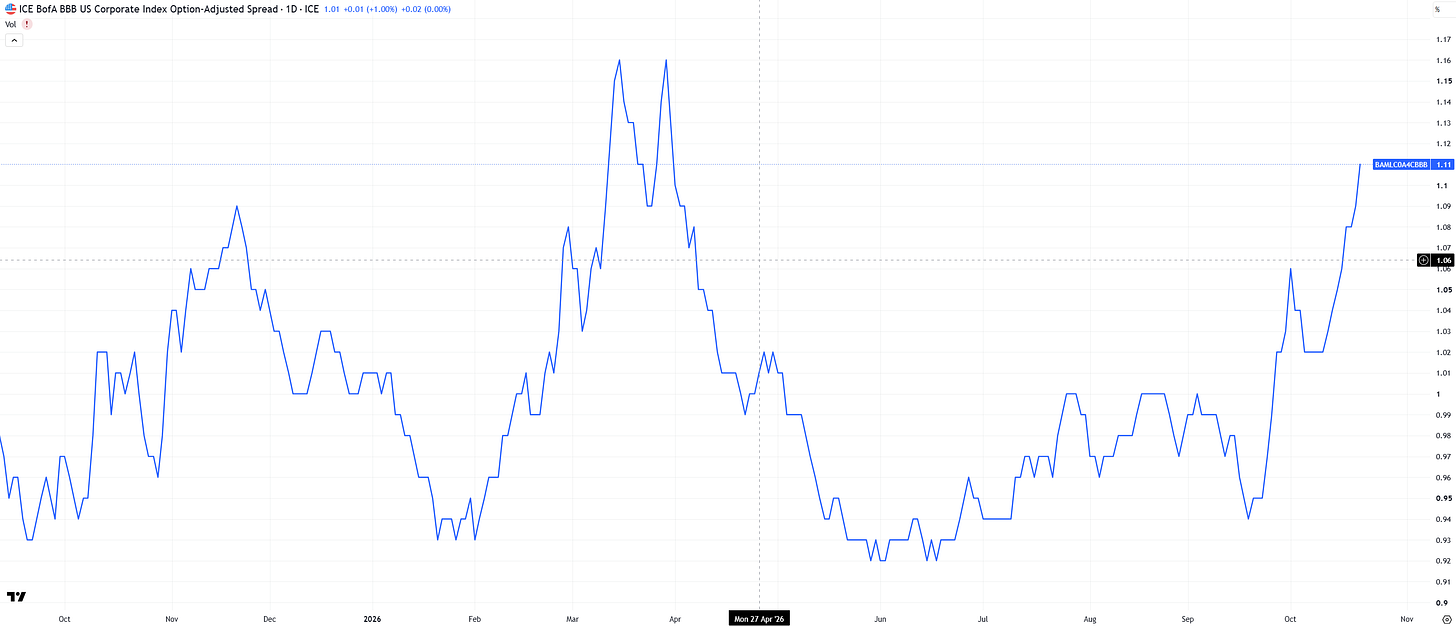
Credit finally relaxed yesterday, with CRWV CDX fading and credit spreads improving. Hopefully the start of a trend for bulls.
Boeing (BA) missed estimates and cut guidance, with 747 production taking longer to stabilize than expected, sending shares -11%.
Robinhood (HOOD) is -8% as venture capital fund losses hurt earnings.
Seagate (STX) is -3% as apparently the beating expectations and rise of guidance wasn’t strong enough, as near-term shipment growth is weak.
Power company Vertiv (VRT) beat and raised guidance, sending shares up 10%.
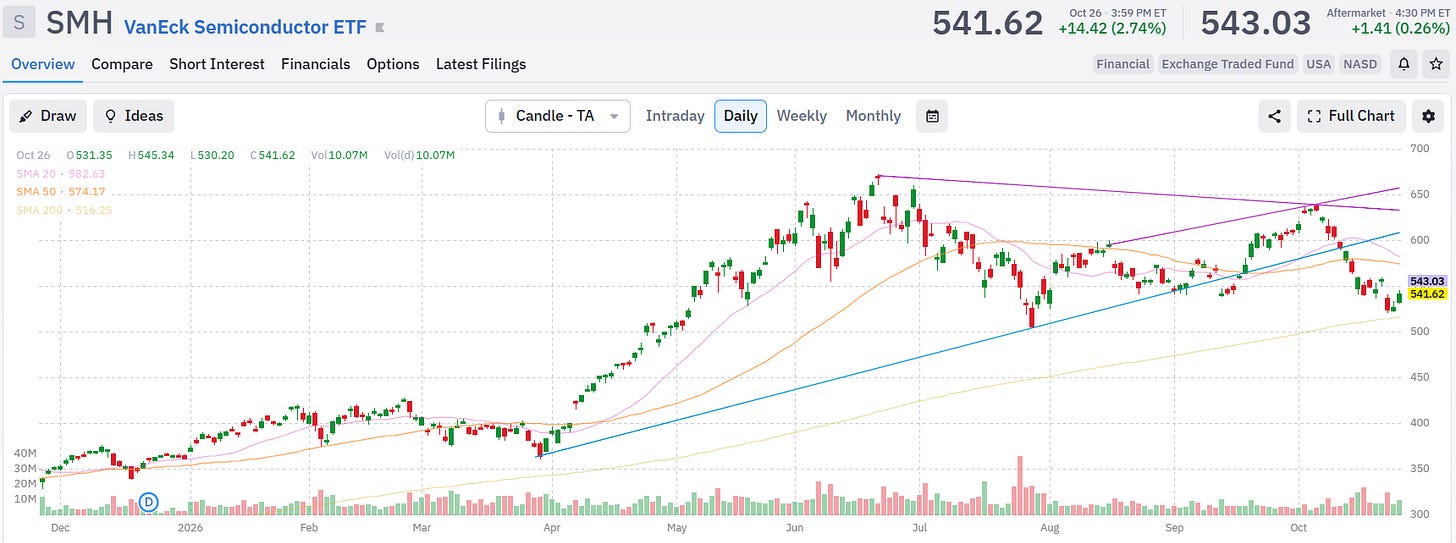
SK Hynix (SKHY) reported record quarterly profits, announced a special dividend and share buybacks, and is up 8%, helping the AI trade.
FOMC meeting today, where a hold is expected, along with Goods Trade data.
MSFT and GOOG report tonight.
Bottom Line: SK Hynix gave AI another boost overnight with very strong earnings and guidance.
Click here to schedule a meeting — I’m here to help you take the next step toward financial freedom.
Disclosures/Regulation:
This content is intended to provide general information about Lloyd Financial. It is not intended to offer or deliver investment advice in any way. Information regarding investment services are provided solely to gain an understanding of our investment philosophy, our strategies and to be able to contact us for further information.
All information has been obtained from sources believed to be reliable, but its accuracy is not guaranteed. There is no representation or warranty as to the current accuracy, reliability or completeness of, nor liability for, decisions based on such information and it should not be relied on as such.
The views expressed in this commentary are subject to change based on market and other conditions. These documents may contain certain statements that may be deemed forward‐looking statements. Please note that any such statements are not guarantees of any future performance and actual results or developments may differ materially from those projected. Any projections, market outlooks, or estimates are based upon certain assumptions and should not be construed as indicative of actual events that will occur.
Past performance is no guarantee of future returns.
Different types of investments involve varying degrees of risk. Therefore, it should not be assumed that future performance of any specific investment or investment strategy will be profitable
Want a clearer view of where you stand? Schedule a free portfolio analysis.
Comments