
Daily Note
The Next Big Thing? What History Teaches Us About Mega IPOs Like Anthropic, LFG Daily - November 19, 2026
If you’ve been saving and investing for years, one question eventually comes up: “Am I actually on the right track?”
Many investors have multiple accounts—401(k)s, IRAs, brokerage accounts—but rarely step back to see how everything fits together. That’s why we offer a Free Portfolio Analysis and 1,000-Foot View Financial Plan.
This complimentary review looks at the big picture of your financial life, including:
• Your overall investment allocation • Hidden risks or portfolio overlap • Fees that may be reducing returns • How your investments align with your long-term goals
Think of it as a financial second opinion—a chance to step back and make sure your strategy is built for the future.
If you’d like clarity and confidence about where you stand, schedule your free portfolio analysis today.
Click here to schedule a meeting — I’m here to help you take the next step toward financial freedom.
Dream Bigger, Sleep Better
Luke Lloyd, CEO Lloyd Financial Group
The Next Big Thing? What History Teaches Us About Mega IPOs Like Anthropic
The biggest investment opportunities of our lifetime often come with the biggest headlines. But history suggests investors should be careful about confusing a great company with a great investment.
There is something exciting about watching a company go public for the first time. It represents the beginning of a new chapter, an opportunity for everyday investors to own a piece of a business that previously may have only been available to venture capitalists, institutional investors, and wealthy private investors.
Today, that excitement is surrounding artificial intelligence company Anthropic, the creator of Claude.
Anthropic is making headlines with what is expected to be one of the largest initial public offerings (IPOs) in history. The company priced its shares at $83, raising approximately $81 billion and reaching an implied valuation of roughly $1.5 trillion.
Think about that for a moment. A company founded in 2021 is entering the public markets with a valuation that puts it among the largest businesses in the world.
It’s an incredible story. But it also raises an important question:
Does investing in the next great company automatically mean you’re making a great investment?
History suggests the answer is no.
We’ve Seen This Movie Before
Every generation seems to produce a technology or business innovation that changes the world.
In the late 1990s, it was the internet. Investors recognized that the internet would fundamentally change how people communicated, shopped, worked, and conducted business.
They were right.
But being right about the technology didn’t necessarily mean being right about the investment.
During the dot-com boom, companies with little revenue, questionable business models, and enormous promises received extraordinary valuations. Investors rushed to participate because they didn’t want to miss the next Amazon or Microsoft.
When the bubble burst, the Nasdaq lost approximately 78% of its value from its March 2000 peak to its October 2002 low.
The internet didn’t fail. Many of the companies and investment valuations did.
Amazon itself experienced a tremendous decline during that period before eventually becoming one of the most successful businesses in modern history.
That distinction matters.
A revolutionary technology can be real while the investment enthusiasm surrounding it gets ahead of reality.
The IPO Track Record Isn’t Always Pretty
Let’s look at some more recent examples.
Facebook went public in 2012 with enormous expectations. Its stock struggled initially, falling substantially below its IPO price before eventually becoming one of the most successful technology investments of the following decade.
Alibaba went public in 2014 in one of the largest IPOs ever. Investors initially celebrated the opportunity, but the stock experienced significant volatility.
Uber went public in 2019 with a valuation of approximately $75 billion. Despite transforming transportation, its stock struggled in the years following its debut.
Rivian went public in 2021 amid enormous enthusiasm surrounding electric vehicles. Its stock initially surged before experiencing a substantial decline.
There are also tremendous success stories. Amazon, Google, and other technology companies demonstrate how early ownership of transformative businesses can create extraordinary wealth.
The lesson isn’t that IPOs are bad investments.
It’s that the initial excitement surrounding a company doesn’t tell us what the stock will ultimately be worth.
Anthropic: A Revolutionary Business With a Lot to Prove
I believe artificial intelligence could be one of the most transformative technologies of our lifetime.
AI has the potential to improve productivity, healthcare, manufacturing, education, financial services, and countless other industries.
Companies like Anthropic are helping lead that transformation.
But investors need to separate the opportunity from the valuation.
Anthropic’s enormous valuation reflects expectations about future growth, not simply what the business is producing today.
There are several important considerations:
1. Expectations are already extremely high.
When a company enters the public markets with a trillion-dollar-plus valuation, investors are already paying for an enormous amount of anticipated future success.
The company doesn’t just need to grow. It needs to grow enough to justify what investors are paying today.
2. Competition is real.
Anthropic isn’t operating in a vacuum. OpenAI, Google, Meta, and other technology companies are investing heavily in artificial intelligence.
The ultimate winners may not be the companies receiving the most attention today.
3. Infrastructure isn’t free.
Building advanced AI requires enormous investments in computing power, data centers, energy, and specialized chips.
Revenue growth is exciting, but investors also need to understand the costs associated with generating that revenue.
4. The economics will eventually matter.
At some point, the market will demand more than exciting announcements and impressive growth rates.
Investors will want sustainable profitability, cash flow, competitive advantages, and evidence that the business can generate attractive returns on the capital being invested.
These are the same fundamentals that matter when evaluating any business.
Don’t Confuse a Great Company With a Great Stock
One of my favorite ways to think about investing is to remember that when you purchase a stock, you’re purchasing ownership in a business.
You’re not simply buying a ticker symbol or participating in a popular story.
You’re buying a claim on that company’s future earnings and cash flows.
A great company can become a terrible investment if you pay too much for it.
Likewise, a company that experiences a difficult period can eventually become a tremendous investment if its underlying business remains strong and the purchase price makes sense.
This is why valuation matters.
It’s also why investment discipline matters even more when excitement is running high.
What Should Investors Do With the Next Big IPO?
For investors interested in participating in opportunities like Anthropic, I believe there are a few important considerations.
First, understand your time horizon. Are you investing for the next six months, five years, or 20 years? Those are very different investment decisions.
Second, understand your risk tolerance. A newly public company can experience enormous price swings as the market determines what it believes the business is worth.
Third, consider position sizing. A concentrated investment in one exciting company can create unnecessary risk, particularly when the valuation already reflects substantial future expectations.
Finally, don’t let fear of missing out dictate your financial decisions.
There will always be another opportunity. The market doesn’t stop producing new businesses, new technologies, and new investment themes.
You don’t have to own every winner to build a successful financial future.
The Bigger Financial Planning Lesson: Own Your Future, Not Just the Headlines
The history of investing is filled with incredible opportunities.
The industrial revolution, automobiles, electricity, computers, the internet, smartphones, and now artificial intelligence have all changed the way we live and work.
Each transformation has created enormous wealth for investors who owned the right businesses at the right prices.
But the people who built lasting wealth weren’t necessarily the ones chasing every new headline.
They understood the importance of having a strategy, managing risk, maintaining liquidity, and allowing investments to compound over time.
That’s particularly important for individuals approaching or already living in retirement.
Your retirement portfolio shouldn’t depend on correctly predicting which AI company will dominate the next decade.
Instead, your investment strategy should be designed around your financial goals, income needs, time horizon, and ability to withstand market volatility.
There is nothing wrong with pursuing growth and participating in transformative technologies. In fact, avoiding innovation altogether can carry its own opportunity cost.
But there’s a difference between participating in innovation and gambling your financial future on it.
The next Amazon might be out there. The next dot-com bubble might be out there, too.
The challenge is knowing the difference and having a financial plan that doesn’t require you to get every prediction right.
At Lloyd Financial Group, we believe investing should start with a plan, not a headline. We want our clients positioned to participate in opportunities while understanding the risks that come with them.
Because ultimately, the goal isn’t to own the next big IPO.
It’s to build a financial future that allows you to live the life you’ve worked hard to create.
Dream Bigger, Sleep Better.
Click here to schedule a meeting — I’m here to help you take the next step toward financial freedom.
Colin Symons, CIO Lloyd Financial Group
All about AI, this week.
NVDA started things well with a great quarter and guidance, along with a buyback.
That should help the ANT IPO tomorrow go well. Demand for the deal seems to have really solidified.
What gets the AI trade back to highs? NVDA and ANT are likely big helpers. What else?
VIX was deeply backwardated, indicating stress can roll off, here. It’s a problem if vol can’t relax.
We’ve seen a lot of stress in the last two weeks from real rates and the dollar.
The dollar to some extent was getting a risk-off bid from AI pain. That can get better.
Real rates strike me as largely a rate-expectations move. Do we get 2 or 4 and how long do we stay there. The chart below says we’re pretty high and the next CPI report is likely to look better.
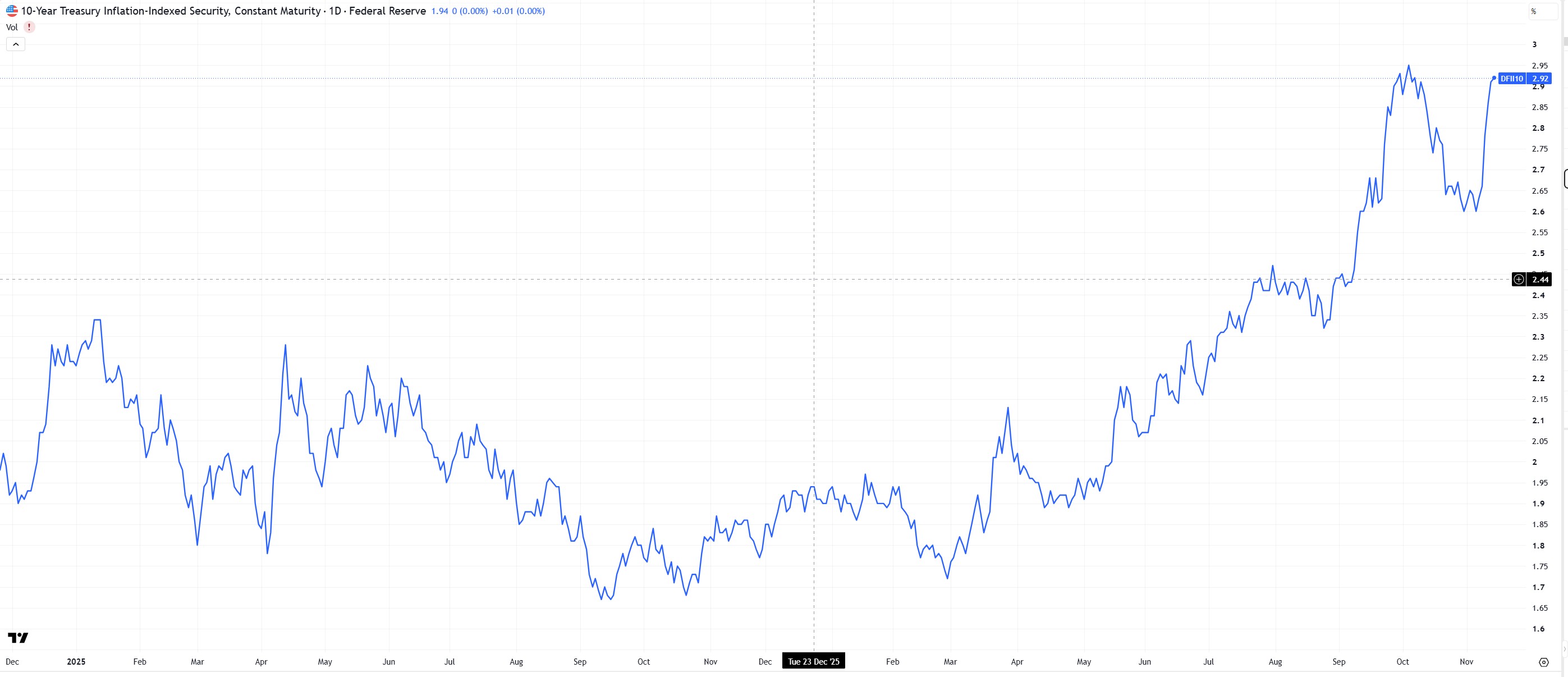
Sentiment also seems awful, with a lot of short positioning and talk. Watching VIX, rates, and the dollar likely shows us who wins.
I think I’m sitting on a lot of stocks that can be up 30%-200%. The setup is there, and we’ll see what happens. I think a lot has the potential to work.
Watch SPX 7400 and 7500 as first steps.
FOMC Minutes did show talk of a 50bps hike, which caused some alarm in stocks, while bonds largely ignored it.
Housing Starts were up more than expected, 1.309MM vs. exp. 1.25MM, while Building Permits were weak, at 1.295MM vs. exp. 1.38MM. Broadly, multifamily is doing well, while single family is not, and that’s the lowest Permits in a year, which isn’t a great sign for the future.
Pending Home Sales dropped -4.7% vs. exp. -2%, with weakness everywhere, but particularly in the West and South.
Fed head Waller, Mr. 50bps hike, once again sent bonds lower by contravening the market, claiming inflation is going the wrong way, and they should hike 50bps in December. I can’t help but notice he got awfully crotchety after getting passed up for the chair… He also said he disagrees with Fed Chair Wash’s refusal to engage in forward guidance. Frankly, ignore this. Shoot against it.
Reports say Leopold Aschenbrenner wants to restart his Situational Awareness hedge fund that has blown up twice this year on aggressive tech bets and contributed to the massive volatility we’ve seen in the back half of this year. I think the nation will agree with me that I’d rather he just stay down.
Healthcare stocks such as United Healthcare (UNH) had their second day of selling due to fears of retroactive Medicare cuts by the CMS, sending UNH -10%. Something like this has already been seen and dismissed in the courts and we are about to have a very healthcare-friendly Congress, so it seems awfully unlikely anything happens and if it does, it would take an awfully long time to see the light of day.
TSM and Samsung are suspending some chip shipments to China after new US rules.
Cybersecurity company Palo Alto Networks (PANW) is up 10% after beating estimates and raising guidance.
Semiconductor equipment company Kulicke & Soffa (KLIC) also beat and raised on booming growth, sending shares up 5%.
Intel (INTC) is up 5% after signing their first external customer for their 18A foundry business to be a competitor to Taiwan Semiconductor (TSM).
ANT IPO is the big event of the day, set to price at $83 after upsizing the offering. We also have Philly Fed Manufacturing, Jobless Claims, and many more Fed speakers.
**Bottom Line: **Lots of excitement leading to the ANT IPO, and no heavy hedging flows have been seen, yet, though they don’t tend to show up until 7:30
Disclosures/Regulation:
This content is intended to provide general information about Lloyd Financial. It is not intended to offer or deliver investment advice in any way. Information regarding investment services are provided solely to gain an understanding of our investment philosophy, our strategies and to be able to contact us for further information.
All information has been obtained from sources believed to be reliable, but its accuracy is not guaranteed. There is no representation or warranty as to the current accuracy, reliability or completeness of, nor liability for, decisions based on such information and it should not be relied on as such.
The views expressed in this commentary are subject to change based on market and other conditions. These documents may contain certain statements that may be deemed forward‐looking statements. Please note that any such statements are not guarantees of any future performance and actual results or developments may differ materially from those projected. Any projections, market outlooks, or estimates are based upon certain assumptions and should not be construed as indicative of actual events that will occur.
Past performance is no guarantee of future returns.
Different types of investments involve varying degrees of risk. Therefore, it should not be assumed that future performance of any specific investment or investment strategy will be profitable
Educational content only. Nothing here is investment, tax or legal advice, and it is not a recommendation to buy or sell anything.