
Daily Note
NVDA Is The Cheapest It’s Ever Been. LFG Daily - November 17th, 2026
If you’ve been saving and investing for years, one question eventually comes up: “Am I actually on the right track?”
Many investors have multiple accounts—401(k)s, IRAs, brokerage accounts—but rarely step back to see how everything fits together. That’s why we offer a Free Portfolio Analysis and 1,000-Foot View Financial Plan.
This complimentary review looks at the big picture of your financial life, including:
• Your overall investment allocation • Hidden risks or portfolio overlap • Fees that may be reducing returns • How your investments align with your long-term goals
Think of it as a financial second opinion—a chance to step back and make sure your strategy is built for the future.
If you’d like clarity and confidence about where you stand, schedule your free portfolio analysis today.
Click here to schedule a meeting — I’m here to help you take the next step toward financial freedom.
Dream Bigger, Sleep Better
Colin Symons, CIO Lloyd Financial Group
Where Do Prices Come From? Honestly, that’s a surprisingly complex question. To make it easier, I’m going to limit the idea to a longer-term idea, rather than all the order book activity, options influence, and all that good stuff that can create temporary, if potentially significant, dislocations.
In simple terms, stock prices come from company earnings times a P/E multiple, which is the question of how much investors are willing to pay for those earnings. Even this idea is somewhat complicated. What do you do with companies that have negative earnings? What makes the P/E ratio change?
Just to address the first question quickly, companies with negative earnings are generally priced on the idea that earnings come eventually. For example, a company like Uber (UBER) had negative earnings for the first six years of its life as a public company before starting to turn a profit in 2023. Despite that, the stock generally held on OK during that period as investors expected future profitability to justify the price, an idea that thus far has worked out OK.
What makes the P/E ratio change? Many things, really. Obviously, earnings have an effect. If earnings go down, P/E goes up. Once again, though, this can quickly get complicated. A trailing P/E is easy, as earnings are already known. A forward P/E, however, can vary on what analysts think, and they can change their mind greatly and potentially somewhat whimsically. If analysts see price moving down, they often reduce growth expectations. Real data matters, but so does sentiment.
Lastly, I have to mention the importance of interest rates, as I view it as the biggest ‘real’ problem for markets. The Fed has been hiking rates, which makes stocks less attractive, as the discount rate for future earnings goes up with a higher risk-free rate. There’s been a lot of chatter about how many more hikes are coming and when, which has aided volatility. This can be viewed as a race between how many hikes we get and how quickly earnings get impacted.
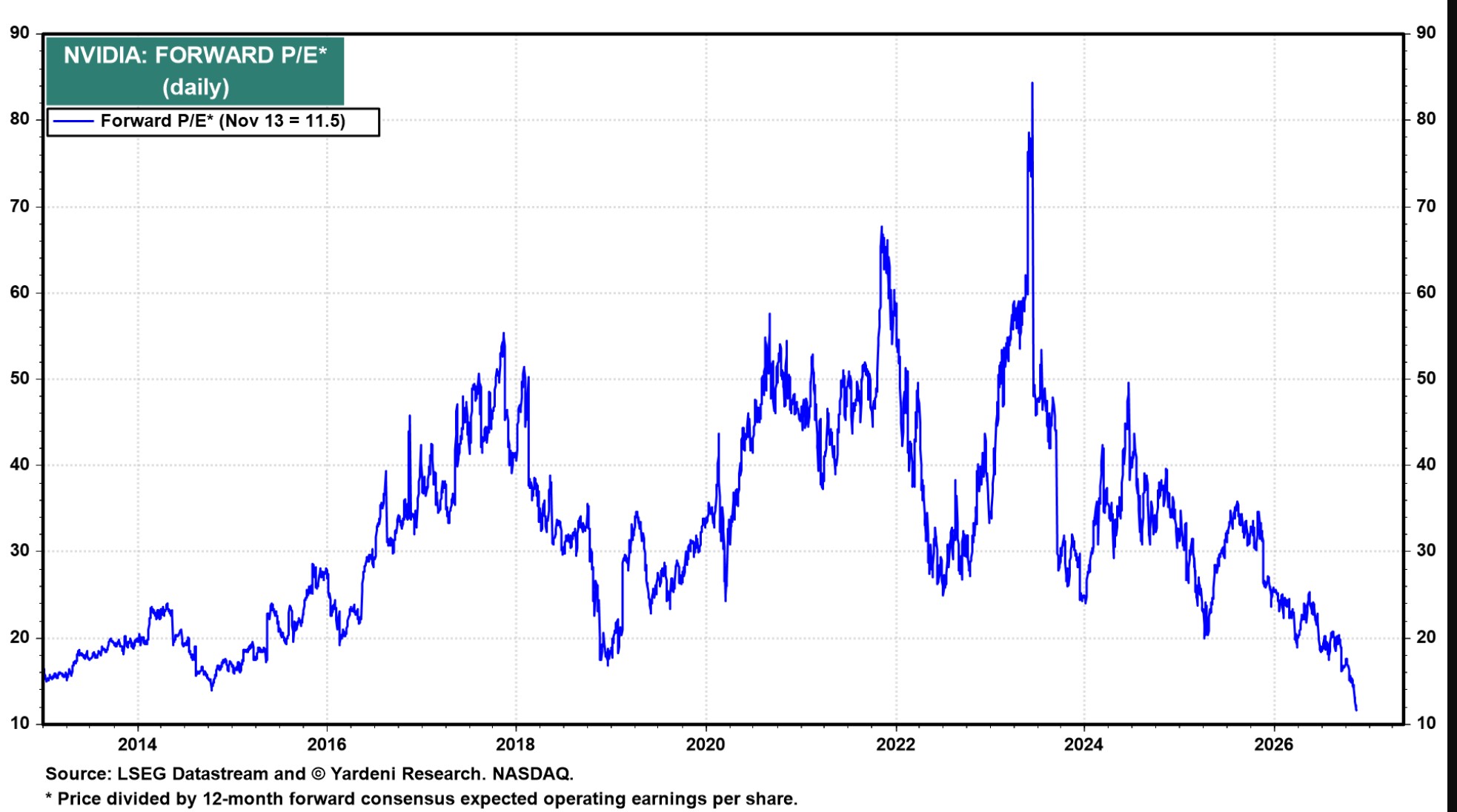
With all that in mind, let’s think about something like Nvidia (NVDA), which reports earnings tomorrow night. The chart below shows the company’s forward P/E over time. What you can see is that this year NVDA rapidly hit the lowest forward P/E ever for the company. That implies the market has relatively modest expectations about Nvidia’s future earnings.
Is that deserved? Based on what we know right now, Nvidia’s growth is still expected to be very strong. There’s not yet any indication that earnings growth has even peaked, yet. Last quarter, CFO Colette Kress, now interim CEO, said they’re supply-constrained– demand is stronger than they can supply. Business still looks very strong.
There are problems, of course. Fears are high that AI growth is peaking. There’s certainly more competition in the space. The latest CEO resignation raised fears, including more focus on how many chips are finding their way to China, something the US is against. At some point, this magnificent growth will slow.
With the stock down -35% from the peak, some number of problems seem priced in, and a forward P/E of around 10 shouldn’t be very demanding. That said, we’ve seen many great AI earnings get sold off as de-grossing continues. Is the AI trade getting sold to make space for the Anthropic deal? Lots can happen off the earnings report.
For our part, we were willing to take a shot that we hit peak AI fear last week. While it’s hard to expect blowout earnings from Nvidia, they seem likely to be quite solid. We don’t own Nvidia specifically but put money behind other names in the space last week on the idea that we should see better times ahead, particularly after we cross Nvidia earnings and the Anthropic IPO. AI will slow eventually, but right now growth still seems solid and valuations are undemanding.
Empire State Manufacturing was weak, at 7.8 vs. exp. 17, with New Orders down a fair amount. Really, nothing looked very good, except Prices Paid going down. Hiring also jumped.
The US tightened restrictions on remote access to advanced AI chips to prevent unwanted access.
The dollar hit the highest level since April 2025.
In all that ugliness yesterday, it’s interesting to note NVDA CDS (default risk) went down sharply. I guess Jensen was a risk factor? CNBC and others reported the board isn’t considering bringing him back.
Retail Sales today, where the expectation is for a bit of a slowdown. There’s also ADP Employment, Industrial Production, and Export/Import Prices. NVDA earnings tonight will be closely watched.
**Bottom Line: **Lots of focus on NVDA earnings tonight
Click here to schedule a meeting — I’m here to help you take the next step toward financial freedom.
Disclosures/Regulation:
This content is intended to provide general information about Lloyd Financial. It is not intended to offer or deliver investment advice in any way. Information regarding investment services are provided solely to gain an understanding of our investment philosophy, our strategies and to be able to contact us for further information.
All information has been obtained from sources believed to be reliable, but its accuracy is not guaranteed. There is no representation or warranty as to the current accuracy, reliability or completeness of, nor liability for, decisions based on such information and it should not be relied on as such.
The views expressed in this commentary are subject to change based on market and other conditions. These documents may contain certain statements that may be deemed forward‐looking statements. Please note that any such statements are not guarantees of any future performance and actual results or developments may differ materially from those projected. Any projections, market outlooks, or estimates are based upon certain assumptions and should not be construed as indicative of actual events that will occur.
Past performance is no guarantee of future returns.
Different types of investments involve varying degrees of risk. Therefore, it should not be assumed that future performance of any specific investment or investment strategy will be profitable
Educational content only. Nothing here is investment, tax or legal advice, and it is not a recommendation to buy or sell anything.