
Daily Note
Is It The End of The AI World? LFG Daily - November 9th, 2026
If you’ve been saving and investing for years, one question eventually comes up: “Am I actually on the right track?”
Many investors have multiple accounts—401(k)s, IRAs, brokerage accounts—but rarely step back to see how everything fits together. That’s why we offer a Free Portfolio Analysis and 1,000-Foot View Financial Plan.
This complimentary review looks at the big picture of your financial life, including:
• Your overall investment allocation • Hidden risks or portfolio overlap • Fees that may be reducing returns • How your investments align with your long-term goals
Think of it as a financial second opinion—a chance to step back and make sure your strategy is built for the future.
If you’d like clarity and confidence about where you stand, schedule your free portfolio analysis today.
Click here to schedule a meeting — I’m here to help you take the next step toward financial freedom.
Dream Bigger, Sleep Better
Colin Symons, CIO Lloyd Financial Group
The market certainly had a tizzy last Thursday, with some record moves, such as the semiconductor index (SMH) falling the second-most since 2008. Why did we get such an outsized move? When something like this happens, there are usually multiple events happening, and thus, multiple reasons for the event.
What I want to focus on here is the idea of how modern money tends to be run, as we’ve seen a lot of stress there, lately, including word of heavy losses, return of capital, and fund closures. This can have a dramatic effect when everyone is on the same side of the boat. Considering modern funds all tend to run in the same way, that move can get violent.
These days, funds tend to focus on factor and rotation flows. I’d say the main problem on Thursday was that we had a factor and rotation shock that spiraled into a historic purge. Funds tend to look at what’s moving their portfolio. A factor is a way to classify how your portfolio is moving, including classic factors such as value, momentum, and quality, or custom factors like AI exposure.
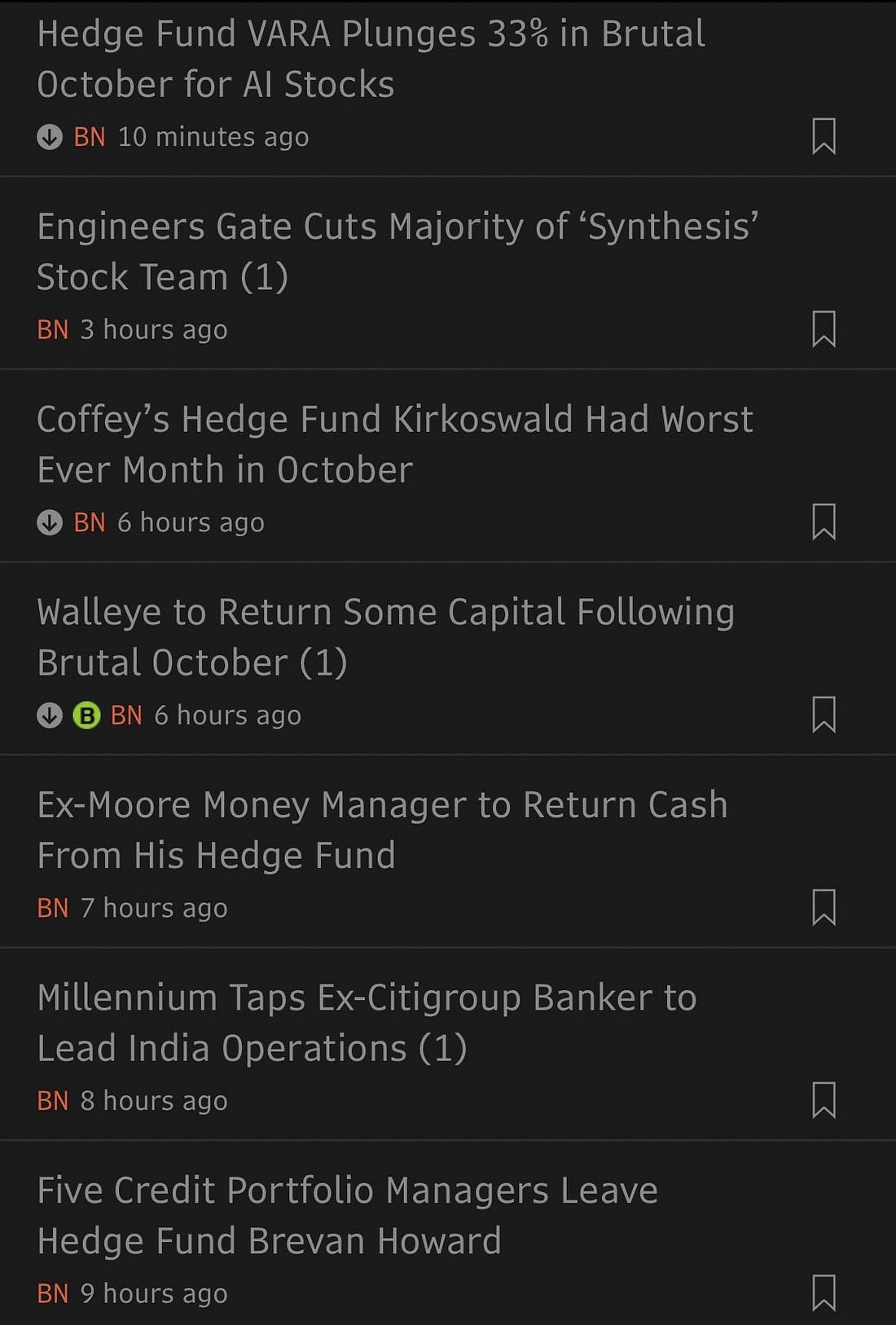
In this case, the AI trade has been quite the darling for a long time. The hedge fund Situational Awareness caused quite a stir in June as their very aggressive trades first sent semiconductors very high, then crashed them. Considering how many investors chase momentum, this caught a lot of people offside (see above.)
The AI trade has been stressed ever since, failing to make new highs. Last week, we had a bit of a confluence of events, where the Democrats, who are louder on regulating AI, won big, along with most ballot measures to regulate AI. We also got an article from Citrini Research talking about how they think the AI infrastructure trade is done.
Whatever the reason, exactly, we got a major factor shock on Thursday, leading to widespread liquidation big enough to hit the rest of the market. Apparently, there were still quite a few people in the AI trade, a lot moved to sell, and we got a sharp move down. According to Citadel’s Head of Global Equities, Justin Lubell, most big-loss events at big funds have been from factor shocks just like this.
The question is what’s priced in. Given the large downturn in AI names, there’s not as much priced in as there used to be. I think it’s very reasonable to think we could have a good bounce. One question that’s probably causing some hesitation is the worry that stressed sellers are still out there. Friday was encouraging, but it may take time to build confidence. Can the AI trade see good gains next week?
According to Nomura’s McElligott, the next few weeks can be choppy before we know market direction, following the big liquidation. The swift downturn created an estimated $72B of mechanical just from vol funds selling just on Thursday, while leveraged ETFs sold a record $48.6B. Broadly, I’d say swing traders are looking at the balance between further de-grossing and the chance for sharp reversion if volatility relaxes and positioning is friendlier. Longer-term allocators tend to view this as a healthy, if painful, pullback. AI demand remains, so this can be an opportunity as long as regulation isn’t overburdensome.
George Soros always had the opinion that if you see a bubble, you should rush towards it. More pertinent to now, he also said that every bubble faces a big test, where reflexive feedback shifts from positive to negative. You don’t want to own the bubble during the test, but if the test fails to clear the bulls, you have a resilient trend, and the acceleration afterwards can extend much higher and longer than many expect. The near-term can still be noisy, but it’s hard to just walk away if you believe Soros’ bubble theory.
Payrolls were expected to be kind of strong, but it was huge, at 165K vs. exp. 65K. The Unemployment Rate went down to 4.1% vs. exp. 4.2%, while Average Hourly Earnings were 0.4% m/m vs. exp. 0.3%. Hard to be an economic doomer with the surprisingly strong jobs we’ve been getting over the last several months. This solidified the idea of a December rate hike, which was already considered likely. While the AI trade had a nice reversion in markets, most stocks were hit, some, as the rate picture got worse.
On 60 Minutes, Trump said he doesn’t plan on escalating the Iran War, saying they don’t have the nuclear material. Oil is down -1%, to just under $90.
Anthropic’s IPO valuation has been slashed from as high as $2T to $1.25-1.75T amidst the tech rout. They’re still targeting an IPO before Thanksgiving.
NVDA is causing trouble as CEO Jensen Huang has admitted to having a relationship with Alice Huang, a Chinese spy. The stock is -4% this morning.
NY Fed Consumer Expectations, today.
**Bottom Line: **More tech focus, after messiness last week and the NVDA scandal.
Click here to schedule a meeting — I’m here to help you take the next step toward financial freedom.
Disclosures/Regulation:
This content is intended to provide general information about Lloyd Financial. It is not intended to offer or deliver investment advice in any way. Information regarding investment services are provided solely to gain an understanding of our investment philosophy, our strategies and to be able to contact us for further information.
All information has been obtained from sources believed to be reliable, but its accuracy is not guaranteed. There is no representation or warranty as to the current accuracy, reliability or completeness of, nor liability for, decisions based on such information and it should not be relied on as such.
The views expressed in this commentary are subject to change based on market and other conditions. These documents may contain certain statements that may be deemed forward‐looking statements. Please note that any such statements are not guarantees of any future performance and actual results or developments may differ materially from those projected. Any projections, market outlooks, or estimates are based upon certain assumptions and should not be construed as indicative of actual events that will occur.
Past performance is no guarantee of future returns.
Different types of investments involve varying degrees of risk. Therefore, it should not be assumed that future performance of any specific investment or investment strategy will be profitable
Educational content only. Nothing here is investment, tax or legal advice, and it is not a recommendation to buy or sell anything.